

 Available in US
Content
Why “Gut Feel” Isn’t a Strategy
I spent the first two years of my betting life convinced I had an eye for football. I watched every match, read every preview, followed every pundit on social media — and I lost money steadily. Not dramatically, not in one awful weekend, but in the slow, grinding way that lets you pretend it isn’t happening. My spreadsheet told a different story from my memory, and the spreadsheet was right.
The problem wasn’t knowledge. I knew the game well enough. The problem was that knowing football and knowing how to bet on football are two completely different skills. Football is 5.8% of the UK adult population placing bets on it every week, generating over a billion pounds in gross gambling yield for bookmakers each year. That money doesn’t flow from punters to operators because people don’t understand the offside rule. It flows because most bettors confuse opinion with edge, conviction with probability, and watching with analysing.
A strategy isn’t a feeling about who’ll win. It’s a repeatable process — a set of rules you apply before every bet that removes your mood, your recency bias and your allegiance from the decision. The day I started treating betting as a system rather than a hobby, my results changed. Not overnight, not with some magic formula, but steadily and measurably. This article is the framework I wish someone had handed me nine years ago: a practical, step-by-step structure that you can adapt, test and refine across a full season.

A Pre-Match Analysis Framework in Five Steps
Every Saturday morning looks the same for me. Coffee, laptop, a clean spreadsheet tab for the weekend fixtures. Before I even glance at odds, I run through the same five steps. The order matters — it’s designed to form an opinion before the bookmaker’s price can anchor your thinking.
Step 1: Context first. What’s at stake for each side? A team fighting relegation in April plays a fundamentally different match from one with nothing to play for. Promotion battles, European qualification, managerial pressure, local derbies — these shape motivation, and motivation shapes intensity. I check the league table, recent results and upcoming fixture congestion. Two matches in five days? Expect rotation.
Step 2: Form beyond the surface. A W-W-D-L-W record tells you almost nothing useful. I look deeper: expected goals (xG) generated and conceded, shots inside the box, chances from open play versus set pieces. A side that won 1-0 from an isolated corner while conceding 2.3 xG is not “in good form” — they’re riding luck that will correct itself. I also split form into home and away, because for some teams the difference is enormous. League-wide, home advantage in English football still adds roughly 0.3 to 0.5 goals to the expected output of the home side.
Step 3: Team news and absences. Injuries and suspensions to key players shift the true probability of a match more than most punters realise. A missing centre-forward might be priced in by the market within minutes, but the absence of a defensive midfielder who controls tempo? That’s often underpriced because casual bettors don’t notice it. I check official club channels and beat reporters — not aggregator accounts that recycle speculation.
Step 4: Head-to-head, used carefully. I treat H2H records as flavouring, not evidence. The last five meetings between two sides might span three different managers, two different formations and a squad that’s been rebuilt twice. If the tactical and personnel context is similar — same coach, same system, same key players — H2H is useful. Otherwise, it’s noise dressed up as data.
Step 5: Form your own price, then compare. This is the step most people skip, and it’s the one that matters most. Before I open a single bookmaker tab, I assign my own rough probability to the match outcomes. Home win 45%, draw 28%, away win 27% — whatever my analysis tells me. Only then do I look at the market odds and convert them to implied probabilities. If my number and the bookmaker’s number differ by enough to cover the margin, I have a potential bet. If they don’t, I move on. This is the foundation of value betting, and without it, everything else is decoration.
The whole process takes me about fifteen minutes per match once it becomes habitual. That sounds like a lot, but I only analyse three to five matches per round — the ones where I have a genuine informational opinion. Trying to bet on every fixture is a trap. The framework works precisely because it forces selectivity.

Flat Staking, Percentage and Kelly: Which System Fits You
Three years into my betting, I hit a purple patch — twelve winners from sixteen bets across two weekends. I felt invincible. So I doubled my stakes. Then I tripled them. The next month wiped out four months of profit in nine days. The picks weren’t even bad; three of those losers lost by a single late goal. The problem was staking. I’d removed the one thing protecting me from variance.
Your staking system is more important than your selection method. That’s not a motivational slogan — it’s a mathematical reality. A mediocre tipster with disciplined staking will outlast a brilliant analyst who sizes bets emotionally. Here are the three main approaches I’ve used and tested over nearly a decade.
Flat staking means every bet is the same size — typically 1% to 2% of your total bankroll. If you start with a 500-pound bankroll, every bet is 5 or 10 pounds regardless of how confident you feel. The advantage is simplicity and emotional protection. You can’t chase losses by inflating stakes because the rule won’t let you. The disadvantage is that it doesn’t differentiate between a bet where you see a 2% edge and one where you see a 10% edge. Every selection gets the same weight.
Percentage staking adjusts the stake to a fixed percentage of your current bankroll. As the bankroll grows, stakes grow; as it shrinks, stakes shrink. This has a built-in safety mechanism: losing runs automatically reduce your exposure. Winning runs increase it. The maths compounds in your favour over time, though the day-to-day experience can feel slow during drawdowns because your absolute stake keeps falling.
The Kelly criterion is the most mathematically rigorous approach. It calculates the optimal stake as a function of your perceived edge and the odds on offer. The formula is straightforward: (edge / odds minus 1) times 100 gives you the percentage of bankroll to stake. If you believe a bet has a true probability of 55% but the odds imply 45%, you have a 10% edge — and Kelly tells you to stake a specific fraction of your bankroll to maximise long-term growth.
In practice, full Kelly staking is aggressive. I use quarter Kelly — one-quarter of the recommended stake — because my probability estimates aren’t precise enough to justify full exposure. Even academic research confirms this caution: bookmaker margins on football typically run 4% to 7%, which means your edge, when it exists, is usually slim. Overestimate your edge by a couple of percentage points and full Kelly will punish you severely.
My recommendation for anyone starting out: flat staking at 1% of bankroll. No exceptions, no “I’m really confident on this one.” Run that for three months, log everything, and only consider Kelly once you have at least 200 bets of data showing a positive yield. The system you choose matters less than the discipline to stick with it.

Tracking Your Bets: What to Log and Why
Ask ten losing bettors what their strike rate is and you’ll get ten confident answers, all wrong. Ask a profitable bettor and they’ll give you the number to two decimal places, broken down by market, league and month. The difference isn’t obsessiveness — it’s that you can’t improve a process you don’t measure.
Every bet I place gets logged in a spreadsheet with the same fields: date, match, market, selection, odds taken, best available odds at the time, my estimated probability, stake, result and profit or loss. That last column — profit or loss in actual pounds — is what keeps you honest. Tracking only by win rate is misleading. A 60% strike rate at average odds of 1.50 is a losing proposition; a 38% strike rate at average odds of 3.00 is profitable.
The two numbers I care about most are yield and closing line value. Yield is net profit divided by total stakes, expressed as a percentage. Anything above 3% over a meaningful sample — at least 500 bets — suggests a genuine edge. Closing line value measures whether the odds you took were better than the final odds before kick-off. Research into machine learning models applied to sports betting found that models optimised for calibration — how well their predicted probabilities match actual outcomes — generate nearly 70% more profit than models optimised purely for prediction accuracy. The same principle applies to your own record: what matters isn’t how often you’re right, but how accurately you estimate probabilities relative to the market.
I also tag each bet with the primary reason I backed it: form-based, xG-driven, team news, market movement or situational angle. After a few hundred bets, patterns emerge. You might discover that your xG-driven bets yield 6% but your “gut feel” bets yield minus 4%. That data tells you exactly where to focus and what to stop doing. Without it, you’re guessing about your guessing.
A simple spreadsheet works. Paid tracking platforms exist, but the format matters less than the habit. Log the bet before kick-off — never after the result, because hindsight will corrupt your records. And update your running totals weekly. The feedback loop between analysis, bet, result and review is the engine of any strategy worth the name.

Handling Losing Runs Without Chasing Losses
March 2022. I went eleven bets without a winner. Not eleven bad bets — seven of them showed positive expected value on review. Three lost to stoppage-time goals. One was a penalty miss. The maths was sound; the variance was brutal. And the temptation to throw a large stake at a “banker” to recover was almost physical.
Losing runs are not a sign that your strategy is broken. They’re a mathematical certainty. At a 50% strike rate, a run of eight consecutive losses has roughly a 0.4% chance of occurring on any given sequence of eight bets — but across a season of 300 or 400 bets, it’s probable that you’ll hit one. At a 40% strike rate, which is realistic for value betting at higher odds, losing streaks of ten or twelve are completely normal. If you can’t stomach that reality, you need to adjust your approach before it adjusts your bankroll for you.
The first rule is mechanical: set a weekly or monthly stop-loss. Mine is 10% of bankroll in a single month. If I hit that limit, I stop betting for the rest of the month and spend the time reviewing my recent selections. This isn’t a punishment — it’s a circuit breaker that prevents catastrophic damage during the exact moments when your emotional state is most compromised.
The second rule is psychological, and it’s harder to follow. Never increase your stake after a loss. The urge to “win it back” is the most destructive impulse in betting, and it’s not limited to reckless amateurs. Research from the University of Bristol found that 13% of adult grassroots footballers in England meet the criteria for problem gambling — five times the rate in the general population. Dr Maria Moxey, who led the study, described it as “a massive problem, which is largely falling under the radar.” Loss chasing is the common thread in almost every story of gambling harm, because it transforms a manageable losing streak into a bankroll-ending spiral.
What actually helps during a losing run: go back to your tracking data. Check whether the recent losses were bad beats on sound selections or whether something in your analysis has drifted. Look at closing line value — if you consistently took prices that were higher than the closing line, you’re finding value even when the results haven’t landed. That’s a sign to trust the process. If your closing line value has gone negative, that’s a genuine signal to pause and recalibrate.
Variance doesn’t care about your discipline. But discipline determines whether variance is temporary pain or permanent damage.

Planning Your Betting Across a 10-Month Season
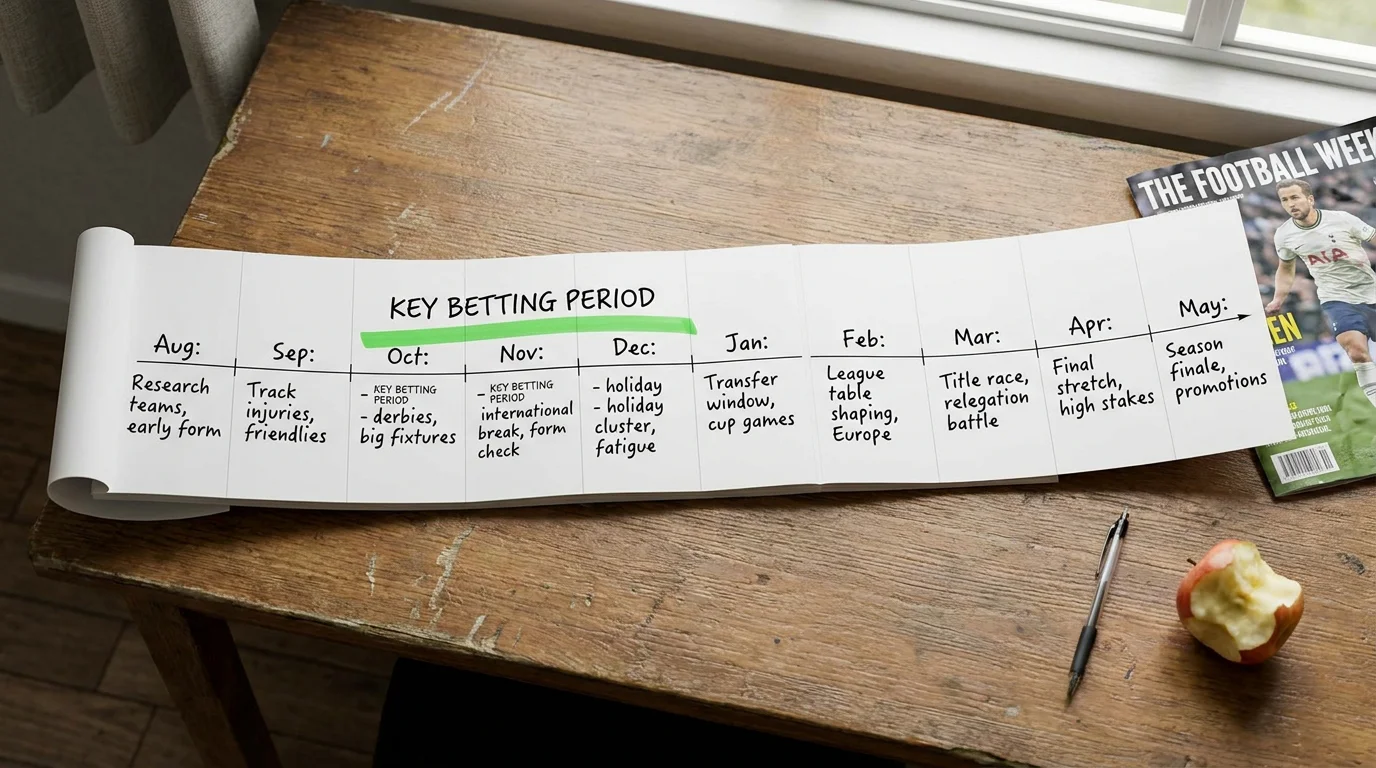
Football betting isn’t a year-round occupation unless you chase obscure summer leagues you know nothing about. The English domestic season runs from August to May, with distinct phases that reward different approaches — and one of the biggest edges I’ve found is simply knowing when to bet more and when to step back.
August and September are volatile. New signings haven’t gelled, promoted teams are adjusting, and managers are still settling on their best elevens. The market has less data to work with, which means odds are softer — but your analysis is softer too. I keep stakes low and focus on teams I’ve followed closely through pre-season. This isn’t the time for bold moves; it’s the time to gather baseline data on how sides are actually performing relative to expectations.
October through December is the sweet spot. Enough matches have been played to establish reliable xG trends, form patterns are genuine rather than sample-size noise, and the fixture schedule gets congested enough to create rotational opportunities that casual bettors miss. The holiday period — three matches in seven days — is where prepared punters profit. Squad depth matters enormously, and the market often fails to price in fatigue and rotation adequately.
January is tricky. The transfer window disrupts squads, managers change, and motivation splits between the FA Cup and league survival. I scale back in January and use the month to update my models with first-half data. February and March bring the business end: relegation battles, top-four races and promotion pushes all sharpen the stakes for the clubs involved. These matches carry emotional intensity that creates biased pricing — the market tends to overvalue sides “in form” and undervalue the desperation of teams fighting for survival.
April and May are high-variance. Some matches are dead rubbers; others are season-defining. The edges here are situational rather than statistical — knowing which teams have something to play for and which are already on the beach. Football betting generates over 1.3 billion pounds in gross gambling yield for UK operators each year, and a significant chunk of that comes from punters who bet indiscriminately in the final weeks without adjusting for context.
The off-season — June and July — is for review. I export my full-season data, calculate yield by month, market and league, and identify what worked. I adjust my framework, update my reference benchmarks and set a bankroll for the new season. This annual cycle of bet, track, review and refine is what turns a collection of bets into an actual strategy.
FAQ
How many bets per week is a sustainable pace?
I place between three and six bets per week during the main season, focusing only on matches where my pre-match analysis identifies a clear discrepancy between my estimated probability and the market odds. More bets doesn’t mean more profit — it usually means more noise. Quality of selection beats volume every time, and forcing bets on fixtures you haven’t analysed properly is the fastest way to erode a bankroll.
What is a realistic ROI for a disciplined football bettor?
Over a full season of 300 to 500 bets, a yield of 3% to 5% on turnover is genuinely strong. That might sound modest, but compounded across a season at consistent stakes, it translates to meaningful profit. Anyone claiming sustained yields above 10% on mainstream football markets either has a very small sample size, is betting into soft lines that won’t last, or isn’t being honest about their record.
Should I specialise in one league or bet across many?
Specialising gives you a deeper information edge. I focus primarily on the Premier League and Championship because those are the leagues I watch, analyse and understand at a granular level. Betting on Serie A or the Bundesliga without the same depth of knowledge just because there’s a match on a Tuesday night is a recipe for average results. Start narrow, build genuine expertise, and only expand once your data proves you can identify value in a new league.
How do I know when my strategy has stopped working?
Track your closing line value over rolling 100-bet windows. If you consistently take prices worse than the closing odds over that sample, your edge has likely disappeared — even if recent results look fine. Markets evolve: bookmakers tighten prices, data becomes more widely available, and angles that worked last season may be priced out this season. A quarterly review of your yield by market and league will show you where the edge is fading before your bankroll does.
