

 Available in US
Content
- The Accumulator Trap — and How to Avoid It
- The Maths Behind Accumulators: Why the House Usually Wins
- Picking Legs: Form, xG and Correlation Checks
- Doubles, Trebles and Four-Folds: How Many Legs Are Too Many
- Acca Insurance and Boosts: Reading the Fine Print
- Sizing Your Acca Stake: Separate Bankroll, Fixed Percentage
- FAQ
The Accumulator Trap — and How to Avoid It
Last January, a mate showed me his betting slip: a seven-fold acca that returned over four thousand pounds from a five-pound stake. He was buzzing. He didn’t mention the forty-odd seven-folds he’d placed that season that returned nothing. By the end of the month, he was down three hundred quid and already building the next “life-changing” acca. That’s the accumulator trap in one anecdote — the big win is visible, the steady bleed is invisible.
Accumulators are the bookmaker’s favourite product for a reason. UK punters place over 290 million online bets on real events every month, and a massive share of those are accas placed on a Saturday morning with a coffee and a prayer. The appeal is obvious: small stakes, enormous potential payouts, and the thrill of watching legs land one by one. The maths, however, is brutal. Every leg you add to an accumulator multiplies the bookmaker’s margin alongside the odds. A four-fold with a 5% margin on each leg doesn’t carry a 5% overall margin — it compounds to roughly 18.5%. By the time you reach a seven-fold, you’re handing the bookmaker a structural advantage that no amount of football knowledge can reliably overcome.
I’m not telling you to never place an acca. I place them myself — occasionally, with strict rules, and with money I’ve ringfenced specifically for high-variance bets. What I am telling you is that building accas without understanding the maths is the most expensive hobby in football betting. Football is the most popular sport for UK bettors, with 5.8% of the adult population placing football bets — and a disproportionate share of that money flows through accumulators because the format is designed to feel exciting rather than to be profitable. This article will show you how to build smarter ones.

The Maths Behind Accumulators: Why the House Usually Wins
Here’s a number that should stop every acca punter in their tracks. Bookmaker margins on standard football match result markets typically run 4% to 7%. On a single bet, that’s manageable — you need a 4% to 7% edge to break even. On a four-fold, those margins compound multiplicatively.
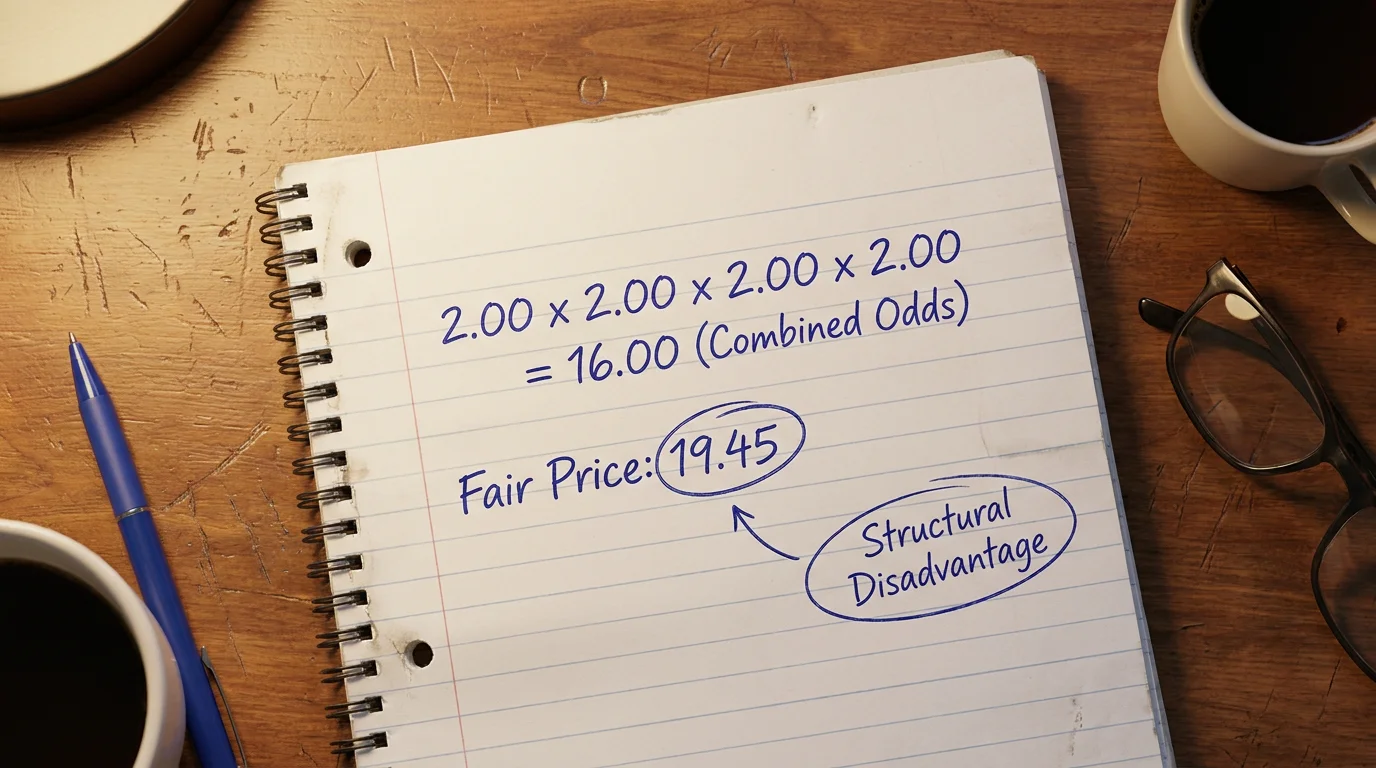
Let me work through it. Suppose you back four selections, each at decimal odds of 2.00 (implied probability 50%). Your combined odds are 2.00 multiplied four times, giving 16.00. A five-pound stake returns eighty pounds. Sounds generous. But each of those 2.00 prices carries a margin. If the true fair odds on each leg are 2.10, the fair combined price would be 2.10 to the power of four, which is 19.45. You’re being offered 16.00 on a bet that’s fairly priced at 19.45. That’s a structural disadvantage of roughly 18%.
Increase it to six legs and the compounded margin approaches 30%. At that point, even if your selections are genuinely well-researched, the house edge is so large that you’d need an implausible individual strike rate — well above 55% at odds of 2.00 — to turn a profit over time. This is why bookmakers promote accumulators so aggressively. They love them. The maths does their work for them.
The counter-argument I hear most often is: “But I don’t need to win often — one big hit covers the losses.” Statistically, that’s true in the very long run for certain structures. Practically, it requires a bankroll management discipline that the vast majority of acca punters don’t apply. They increase stakes after losing runs, chase the previous weekend’s near-miss, and end up spending far more than they’d planned. The maths of accumulators is only sustainable if you treat them as an entertainment expense with a fixed, small budget — or if you apply the structural principles in the next section to reduce the compounded margin.
Consider a simple exercise. Take every four-fold you’ve placed in the past three months and calculate what your return would have been if you’d placed the same selections as four individual singles instead. In the majority of cases, the singles approach produces better long-term results because each bet succeeds or fails independently — one losing leg doesn’t obliterate the profit from the other three. The accumulator structure only rewards you when all legs win simultaneously, which is a much rarer event than people’s intuition suggests. A four-fold at 50% per leg wins roughly 6.25% of the time. That means you need to survive fifteen or sixteen consecutive losses on average before landing one — and the emotional toll of that drought is where most acca punters lose discipline entirely.

Picking Legs: Form, xG and Correlation Checks
If you’re going to place accas — and most of us will — the selection process matters far more than it does for singles. A weak leg on a single costs you one unit. A weak leg on a four-fold wipes out the entire bet. Every selection needs to earn its place.
I start with xG. Expected goals data strips away the noise of actual scorelines and shows you the quality of chances a team has been creating and conceding. A side generating 1.8 xG per match but scoring only 1.1 goals is underperforming its attacking process — that’s a candidate for a goals-related leg. A team conceding 0.9 xG per match but shipping 1.5 goals has been unlucky defensively — their clean sheet odds may be underpriced. Research on xG-based models across eleven Bundesliga seasons found returns of approximately 10% at average market odds, and the underlying logic applies just as well to accumulator leg selection as it does to singles.
Form analysis is next, but I mean genuine form — not the W-D-L string on the league table. I look at the last six matches broken down by xG for and against, shots inside the box, and whether results were driven by repeatable processes or one-off events. A team that won three in a row via set pieces from a brilliant dead-ball specialist is in different “form” from one that won three in a row by dominating open play. The latter is more sustainable.
Then — and this is the step most acca builders skip entirely — I check correlation between legs. If you’re backing Team A to win and over 2.5 goals in a separate match involving Team B, those legs are independent. Fine. But if you’re backing Team A to win and also backing over 2.5 goals in the same match, those outcomes are positively correlated. Home wins and overs tend to go together, particularly when the home side is a strong favourite. The bookmaker prices this correlation out of same-game multis, but many punters don’t realise that even across different matches, certain types of selections introduce hidden correlation. Backing three heavy home favourites in the same acca means you’re exposed to the systemic risk that upsets happen in clusters — and on any given Saturday, they frequently do.
My rule: at least one leg in every acca should be an outcome I’d bet as a single. If I wouldn’t stake a unit on it alone, it shouldn’t be in a multi. The BTTS market is popular in accas precisely because it feels low-risk, but feelings and probabilities are different things. Apply the same analysis to every leg regardless of market.

Doubles, Trebles and Four-Folds: How Many Legs Are Too Many
The short answer: fewer than you think.
I cap my accas at four legs. That’s not an arbitrary number — it’s based on years of carefully tracking my results by accumulator size and finding that the compounded margin beyond four selections consistently outweighs any advantage my analysis provides. Your experience might differ, but the maths is directionally consistent for everyone.
Doubles are the purest form of accumulator. Two legs, two opportunities for the margin to compound, and a realistic chance of landing if both selections are well-researched. A double at combined odds of 4.00 to 5.00 offers a meaningful payout without the long-shot mentality that infects bigger accas. I use doubles when I have two strong value selections on the same day and want a combined return without the full risk of two separate singles.
Trebles add another layer of risk but still keep the compounded margin below 15% on most match result markets. Three well-chosen legs at average odds of 2.00 each return 8.00 — a twenty-pound stake returning a hundred and sixty. That’s a satisfying return that doesn’t require lottery-level luck. The key with trebles is diversity: spread your legs across different leagues or different market types to reduce correlation.
Four-folds are my upper limit. At combined odds of 16.00, you’re in territory where one leg going wrong — a 93rd-minute equaliser, a dubious penalty, a sending off that changes the match — collapses the entire bet. The emotional sting of a four-fold that fails on the last leg is disproportionate to the analytical lesson, and I’ve seen too many bettors let that sting drive their next decision.
Five legs and above? I treat those strictly as entertainment. The compounded margin is too large to overcome with skill, the variance is extreme, and the required strike rate across all five selections makes sustained profitability implausible. If you enjoy the thrill of a big acca on a Saturday, allocate a small, fixed sum — I use 1% of my monthly acca budget — and accept it as an entertainment cost, not an investment strategy. The occasional big hit will feel fantastic, and it is. Just don’t let that feeling rewrite your memory of the fifty that didn’t land.
Acca Insurance and Boosts: Reading the Fine Print
Every major UK bookmaker runs some version of acca insurance — place a five-fold, and if one leg lets you down, your stake comes back as a free bet. It sounds like a safety net. In practice, it’s a carefully engineered incentive to add more legs to your accumulator, which is precisely what the bookmaker wants you to do.
The mechanics reveal why. Acca insurance typically requires a minimum number of legs — usually five — with each selection at minimum odds of 1.20 or higher. The refund comes as a free bet, not cash, which means it carries a built-in discount: the average return on a free bet is roughly 70% to 80% of its face value because you don’t get the stake back on a free bet win. So your “insurance” is really worth 70% to 80% of your original stake, conditional on exactly one leg failing. If two legs fail, you get nothing. If all legs win, the insurance was irrelevant. The narrow window in which it activates is smaller than it feels.
Acca boosts work differently. A bookmaker offers enhanced odds on a pre-built accumulator — typically a treble or four-fold on that weekend’s most popular matches. The boosted price looks generous until you convert it to implied probability and compare it to the true price you’d get by backing the same legs individually at best available odds across multiple bookmakers. In my experience, the “boost” often matches or barely exceeds what smart odds shopping would have given you anyway — and it locks you into the legs the bookmaker has chosen rather than ones your own analysis supports.
Entain, one of the UK’s largest operators and owner of several well-known high street brands, described maintaining “well-balanced regulatory frameworks alongside proportionate tax regimes” as critical to the sector. That’s the corporate perspective. The punter’s perspective is simpler: every promotional product exists because it’s profitable for the operator. That doesn’t mean you should never use them — it means you should use them with your eyes open. If an insured five-fold with your own value selections and best-price odds shopping offers a genuine structural advantage over an uninsured four-fold, take it. But don’t add a fifth leg just to qualify for insurance. The cost of that extra compounded margin almost always exceeds the expected value of the free bet refund.
Remote betting in the UK — football included — generates over 2.6 billion pounds in annual gross gambling yield, and promotional products like acca insurance are a core part of how operators maintain that revenue. Treat every offer as a pricing decision, not a gift.

Sizing Your Acca Stake: Separate Bankroll, Fixed Percentage
The biggest mistake I made with accumulators in my early years wasn’t the selections — it was the staking. I’d use the same bankroll for singles and accas, which meant a bad weekend of accas would eat into the capital I needed for my value singles. Two different bet types with two different variance profiles should never share the same pot of money.
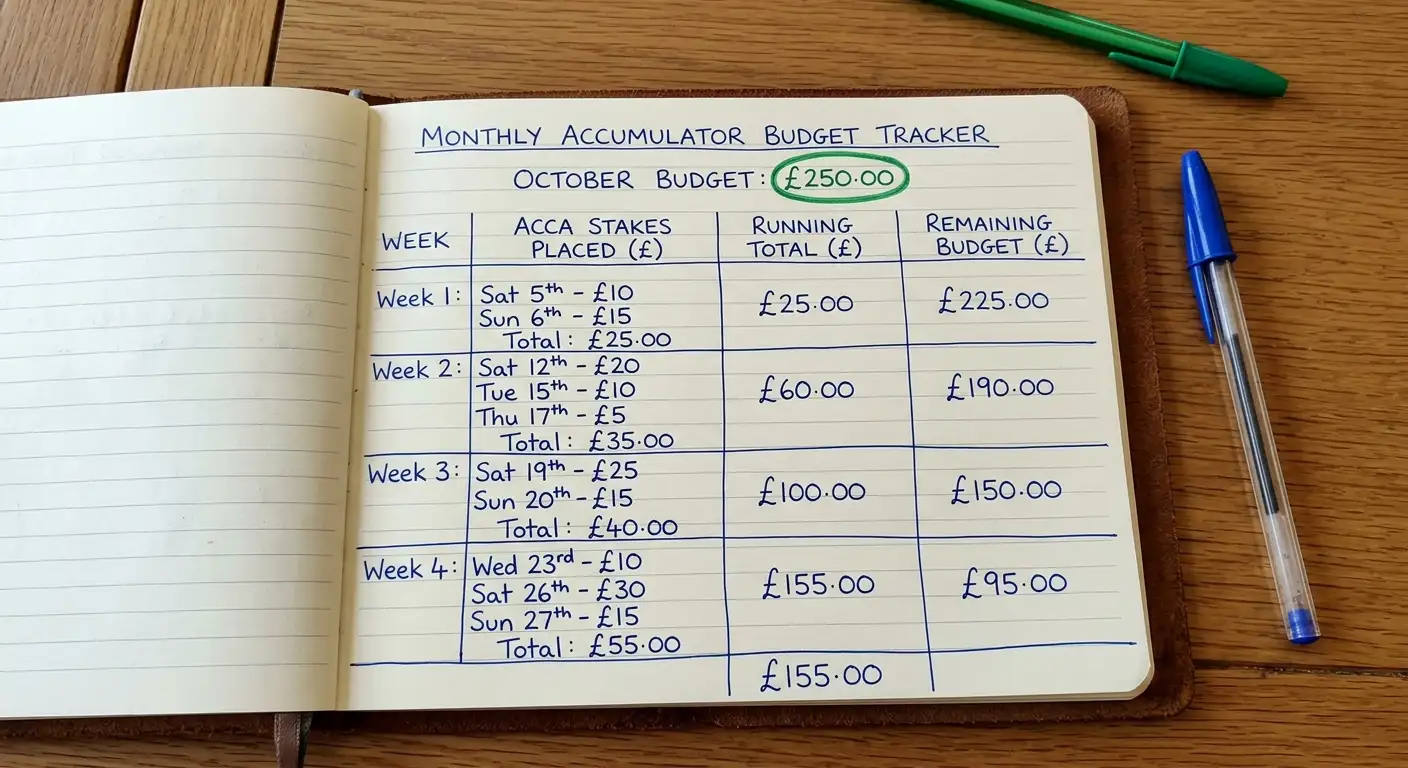
I now allocate 10% of my total monthly betting bankroll to accumulators. That’s a hard ceiling, not a guideline. If my monthly budget is five hundred pounds, fifty goes to accas and four hundred and fifty to singles. Once the acca budget is gone, I stop — no matter how strong the Saturday fixture list looks. This separation protects the core strategy and lets me enjoy accas without the anxiety of watching them erode my main bankroll.
Within that acca budget, I use flat stakes. Every accumulator gets the same amount. This removes the temptation to overweight the “banker” four-fold while underweighting the more speculative treble. In practice, if I have fifty pounds for the month and I plan to place five to eight accas across four weekends, each one gets roughly six to ten pounds. The uniformity is the point — it prevents you from inflating stakes on the back of last week’s near-miss.
One final principle: don’t reinvest acca winnings into more accas. If a four-fold lands and returns a hundred pounds, that money goes back into the main bankroll or into your pocket. The moment you start rolling acca profits into bigger accas, you’ve crossed from strategy into gambling on gambling, and the compounding margin will eat you alive.
I keep a simple monthly log: date, legs, odds, stake, result. At the end of each month, I check two things — total acca spend versus my budget limit, and whether I added legs to any acca for reasons other than analytical conviction. If I find even one bet where I included a fifth leg just because the fixture “felt safe,” I know my discipline slipped. The log keeps me accountable in a way that memory never could.
FAQ
How many legs should an accumulator have to be worth placing?
I cap at four. Doubles and trebles offer the best balance between payout potential and manageable compounded margin. Beyond four legs, the bookmaker’s structural advantage grows faster than most punters’ analytical edge can compensate for. If you want the thrill of a longer acca, allocate a small fixed amount and treat it as entertainment rather than strategy.
Is acca insurance worth using?
Only if you were already planning to place a qualifying accumulator with legs you’ve individually analysed and selected. Adding a fifth leg purely to trigger the insurance almost always costs more in compounded margin than the free bet refund is worth. Use insurance when it aligns with your existing selections — never let it dictate your selection count.
Should I mix leagues in a football accumulator?
Mixing leagues reduces correlation between legs, which is generally a good thing. Three home wins from the Premier League are more likely to fail together than one from the Premier League, one from the Championship and one from La Liga. That said, only include leagues you genuinely analyse. Adding a Bundesliga leg because you need a fourth selection and you’ve heard the favourite is strong defeats the purpose of research-driven acca building.
Are BTTS accumulators more profitable than match-result accas?
Not inherently. BTTS markets carry their own margin and their own biases — the ‘yes’ side tends to be slightly overpriced because it attracts more casual money. The profitability depends entirely on your ability to identify value within the market, not the market type itself. I mix market types within accas based on where my analysis finds edge rather than defaulting to one market for convenience.
