

 Available in US
Content
Every Price Has a Hidden Tax
I spent my first two years placing football bets without once checking whether the odds I accepted were fair. Not “fair” in the emotional sense — fair in the mathematical sense. Every single price a bookmaker offers contains a built-in margin, a slice of the pie they keep before the game even kicks off. On a typical Premier League match, that margin sits between 4% and 7%, and on busy Saturday fixture lists with dozens of markets open, the cumulative drag on your bankroll is enormous.
Think of it like a currency exchange at the airport. You know the mid-market rate for euros, but the bureau shaves a percentage off each side. The bookmaker does the same thing: they take the true probability of every outcome, inflate each price slightly so the percentages add up to more than 100%, and pocket the difference. That difference is called the overround, and until you can spot it, you are betting blind.
Remote betting alone generated GGY of £2.6 billion in the year to March 2025, with football accounting for half of that — £1.3 billion. That revenue does not appear by magic. It comes from the margin embedded in millions of individual bets placed by punters who never thought to check the maths. This article gives you the maths.
The Overround Formula With a Worked Example
The overround is the simplest diagnostic tool in betting. It tells you exactly how much extra the bookmaker is charging on a given market. Here is how to calculate it, step by step.
Take any three-way football market — home, draw, away. Suppose the decimal odds are: Home 2.10, Draw 3.40, Away 3.60. For each outcome, convert the decimal odds into an implied probability by dividing 1 by the odds:
Home: 1 / 2.10 = 0.4762 (47.62%)
Draw: 1 / 3.40 = 0.2941 (29.41%)
Away: 1 / 3.60 = 0.2778 (27.78%)
Now add those percentages together: 47.62 + 29.41 + 27.78 = 104.81%. In a perfectly fair market, those three numbers would sum to exactly 100%. The 4.81% surplus is the overround — the bookmaker’s built-in edge before a single ball is kicked.
To express the margin as a percentage of stakes rather than of the book, divide the overround by the total and multiply by 100: (104.81 – 100) / 104.81 = 4.59%. That means for every £100 wagered across all three outcomes in proportion to implied probability, the bookmaker expects to keep roughly £4.59 regardless of the result.
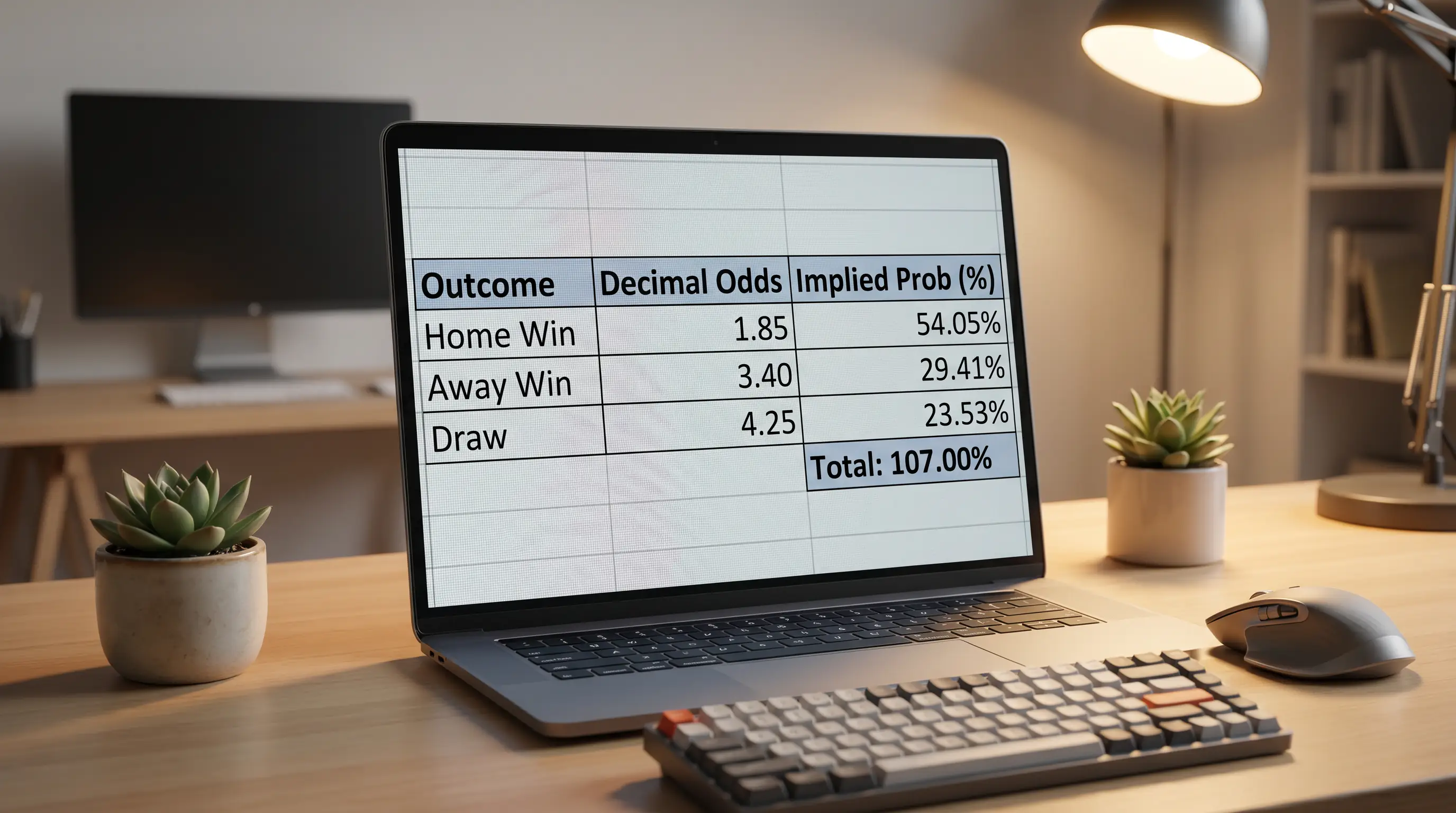
I run this calculation on every market I consider. It takes fifteen seconds with a phone calculator, and it immediately tells me whether I am looking at a competitive book or a bloated one. Once you get used to it, you start to see patterns: margins tighten when bookmakers compete for attention on marquee fixtures and widen on lower-profile games where fewer punters bother to compare.
A useful shorthand — if the implied probabilities sum to 103% or less, you are dealing with a sharp book. Above 106%, the bookmaker is taking a generous cut, and you need a much stronger opinion on the match to overcome that drag. Champions League finals and major international tournaments often see margins compress to around 3%, because every operator in the market is fighting for the same eyeballs.
One more thing worth noting: the overround is not distributed evenly across all outcomes. Bookmakers tend to load more margin onto the outcome that casual punters back most — typically the home win or the favourite. If you are pricing up a market and the home win looks suspiciously short, that is often where the extra juice lives.

Comparing Margins Across Match Result, BTTS and Totals
Not all markets carry the same tax. I learned this the hard way after months of betting correct scores, blissfully unaware that the margin on a 20-outcome market can reach double digits while the three-way match result on the same fixture sat below 5%.
Match result is the flagship market. It attracts the highest volume and the most sophisticated money, so bookmakers keep margins competitive to avoid losing sharp customers to rivals. On a Premier League Saturday, you will typically see overrounds of 4-5% across the three-way market. Move to the Championship and margins nudge up toward 5-6%, because fewer people are comparing prices and the operators face less pressure to sharpen up.
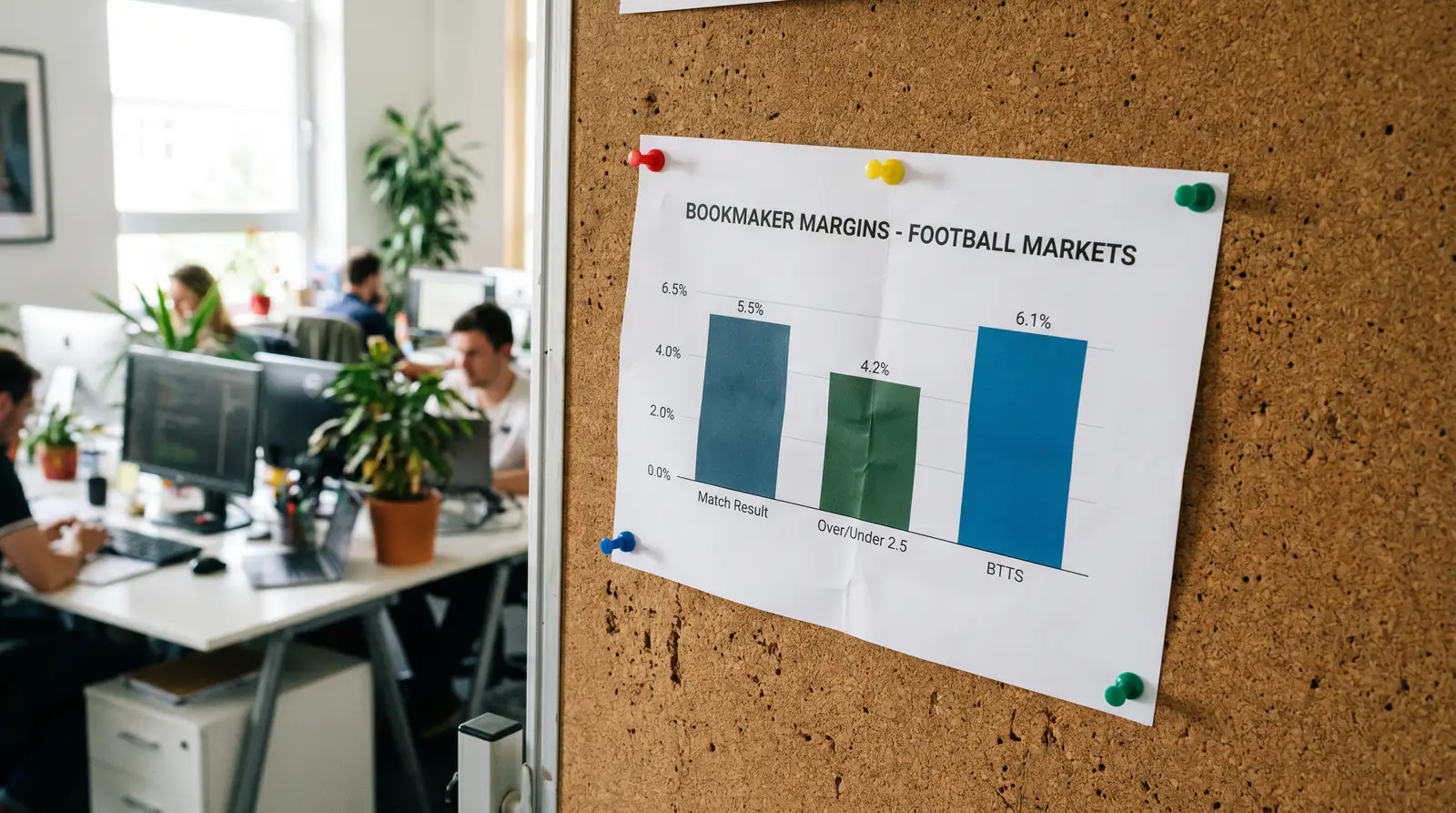
Both Teams to Score is a two-outcome market — yes or no — and you might assume a simpler market means a tighter margin. Sometimes it does. On headline fixtures, BTTS margins can sit around 4-5%. But on midweek League One games, I have seen them balloon to 8% or more, because the bookmaker knows you are unlikely to shop around at 7:45pm on a Tuesday.
Over/Under 2.5 goals behaves similarly. Two outcomes, but the margin depends heavily on the fixture profile. The busiest Premier League games attract overrounds of 4-5%, while niche markets — over 3.5, over 4.5, alternative lines — carry wider margins because fewer punters are checking the maths.
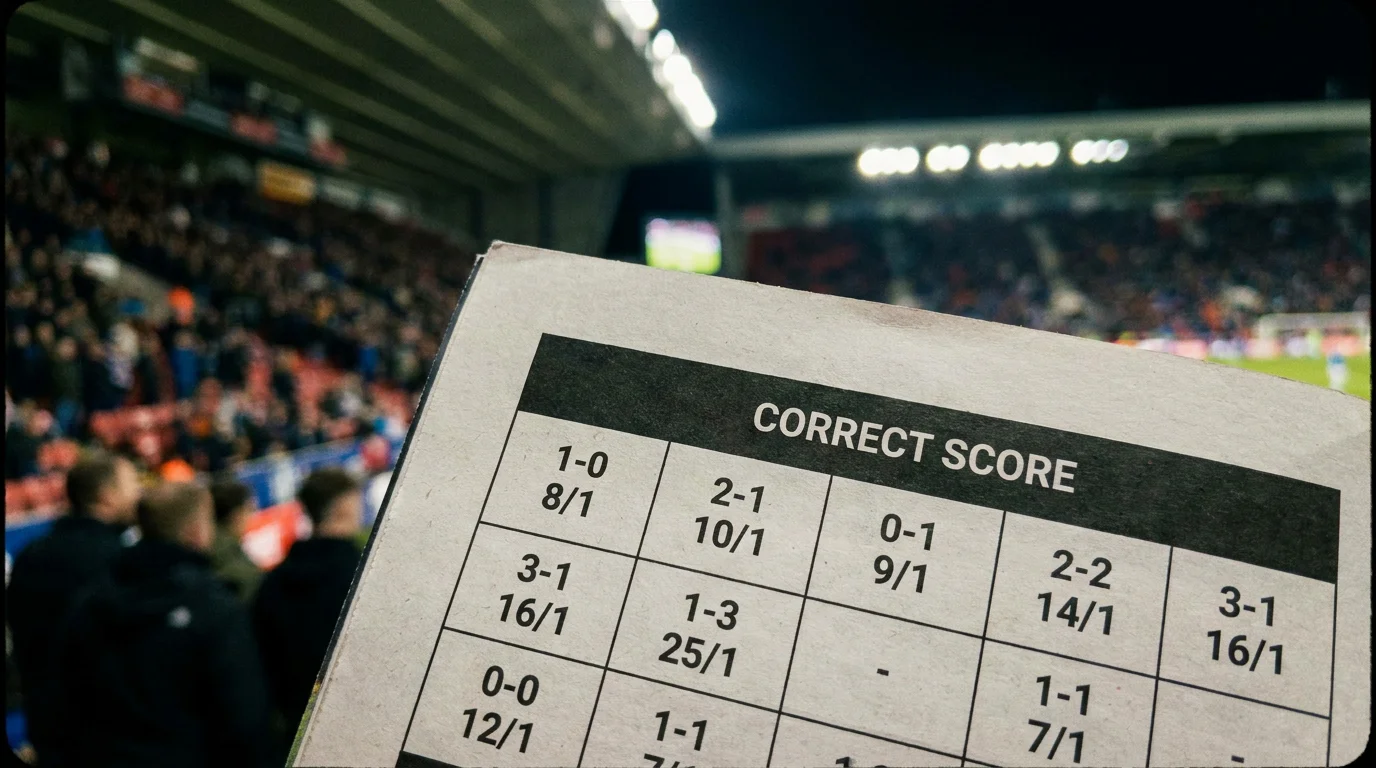
Correct score is where margins get truly punitive. With ten to fifteen realistic scorelines and several more at long odds, the implied probabilities can sum to 130-150%. That means the bookmaker is keeping 20-30% of the theoretical handle before variance even enters the picture. I am not saying never bet correct scores, but I am saying you need to understand the cost of entry before you sit down at that table.
Player markets — anytime goalscorer, shots on target, cards — are harder to audit because the number of outcomes varies and some bookmakers do not publish odds on every player. As a rule of thumb, the more outcomes in a market, the more room the bookmaker has to hide margin. If you cannot calculate the overround because the market is too fragmented, treat that as a warning sign.
The practical takeaway: focus your bets on markets where you can actually verify the margin. Match result, BTTS, and over/under 2.5 goals are the easiest to audit, and they are the markets where sharp money competes hardest, which keeps the overround honest. If you want to go deeper into identifying genuine value bets in football, understanding margin is the non-negotiable first step.
What is a good bookmaker margin for football?
On a Premier League three-way match result market, anything below 4% is sharp and 4-5% is standard. Above 6% signals a less competitive book. Two-outcome markets like BTTS or over/under 2.5 goals should sit around 4-5% on major fixtures. If you consistently see margins above 7%, compare prices across operators before placing the bet.
Do betting exchanges have lower margins than bookmakers?
Yes, in most cases. Exchanges do not set odds — they match bettors against each other and charge a commission, typically 2-5% on net winnings. Because the odds are set by the market rather than a bookmaker, the effective overround on popular football markets can drop below 2%. The trade-off is thinner liquidity on lower-league and niche markets, where you may struggle to get matched at the price you want.
