
 Available in US
Content
Beyond the Disclaimer: Practical Steps for Every Punter
Every betting site displays a responsible gambling disclaimer. Every one. And almost nobody reads them, because they are written in corporate language designed to satisfy regulators rather than help actual people. I have read hundreds of them over nine years in this space, and the gap between what those disclaimers say and what punters actually need to hear is enormous.
Research from the University of Bristol found that 13% of adult grassroots footballers in England meet the criteria for problem gambling — five times the rate found in the general population. Among male players, the figure reaches 16.4%. These are not abstract numbers. These are people who play Sunday league, watch the Premier League, and use the same betting apps you do. If one in eight amateur footballers is experiencing gambling harm, the scale of the issue across the wider population is far larger than a disclaimer can address.

Deposit Limits, Time-Outs, Reality Checks and GamStop
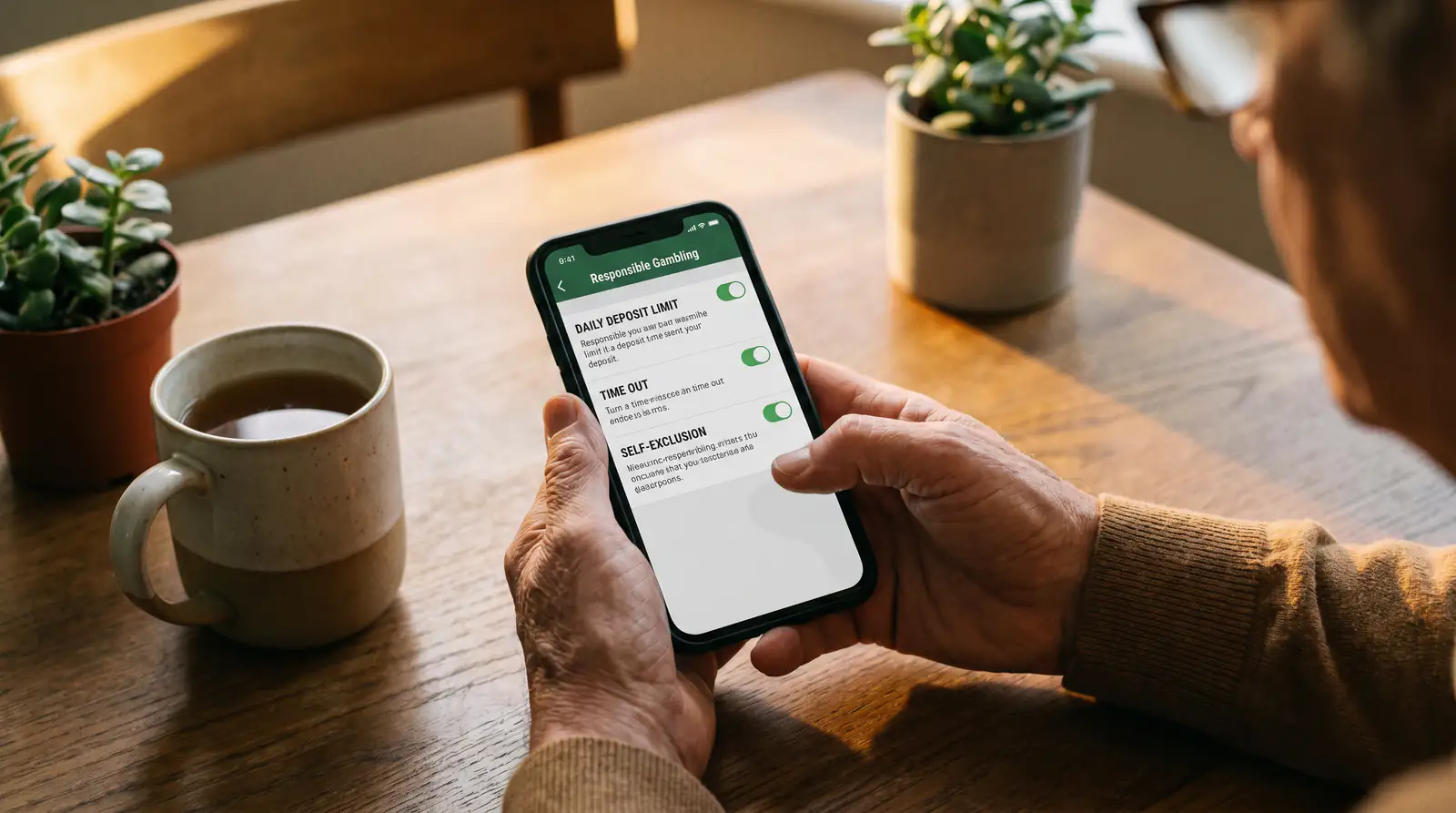
The tools exist. They are built into every licensed UK betting platform. The problem is that most people do not know they are there, or how to use them effectively.
Deposit limits are the most powerful tool available to any recreational bettor. You set a maximum amount you can deposit per day, week, or month, and the operator enforces it automatically. The limit cannot be increased instantly — a cooling-off period of at least 24 hours applies. This asymmetry is the point: it is easy to lower your limit in a moment of clarity and hard to raise it in a moment of impulsivity. I set my deposit limit before I placed my first bet, and I have adjusted it upward exactly twice in nine years, both times after a deliberate review rather than an emotional reaction.

Time-out options let you suspend your account for a set period — typically 24 hours, 48 hours, seven days, or 30 days. During the time-out, you cannot log in, place bets, or deposit funds. This is useful after a bad session or when you recognise that your decision-making has been compromised by frustration, alcohol, or fatigue. I use the 24-hour time-out more often than I would like to admit, usually on Sunday evenings after a losing Saturday.
Reality check reminders are pop-up notifications that tell you how long you have been logged in and how much you have wagered during the session. They are easy to dismiss — a single click and they disappear — but they serve a genuine purpose. The difference between thinking you have been betting for 20 minutes and learning you have been at it for two hours is often the nudge that makes you close the app.
GamStop is the national self-exclusion scheme. Registering with GamStop blocks you from all UKGC-licensed gambling sites for a minimum of six months, with options for one year or five years. It is the most serious intervention available, and it is free. GamStop covers online gambling only — it does not extend to betting shops or casinos, though separate self-exclusion schemes exist for those. If you are at the point where you need GamStop, use it. There is no shame in recognising that a product designed to be compelling has become too compelling for you.

Seventy-three percent of UK adults believe that gambling poses a danger to family life. That statistic reflects a society-wide awareness that the tools above are not just features for people with problems — they are preventive measures that any responsible bettor should understand and use proactively.

Recognising Problem Gambling: A Checklist That’s Actually Useful
Robin Ireland, Director of Research at Healthy Stadia, has described gambling as a public health issue with a significant burden of harm and huge potential for future damage driven by remote gambling technology available 24 hours a day. The clinical criteria for problem gambling are well established, but most punters do not recognise them in their own behaviour until the damage is already severe.
Here are the signals I have learned to watch for, in myself and in friends who bet. Betting more than you planned, not once as a one-off, but regularly. Feeling restless or irritable when trying to cut back. Returning to bet the day after a loss specifically to try to recover the money. Lying to family or friends about how much you bet. Borrowing money to fund betting. Missing work or social commitments because of time spent gambling. Feeling that you need to bet with increasing amounts to get the same level of excitement.
Any one of those signals on its own is not necessarily a crisis. Two or three occurring together over a period of weeks is a pattern that deserves honest self-assessment. The University of Bristol study found that 70% of grassroots footballers were classified as “at risk” of gambling harm, compared with around 15% in the general population. Most of those at-risk individuals would not have identified themselves as problem gamblers — the harm creeps in gradually, disguised as routine.

If you recognise these patterns in yourself, the first step is not to feel ashamed. It is to use the tools described above — deposit limits, time-outs, GamStop — and to talk to someone. The National Gambling Helpline provides free, confidential support. Your GP can refer you to specialist services. The worst thing you can do is nothing, and the second worst is trying to fix it by “winning it back.” For a deeper look at the cognitive traps that make gambling harm harder to recognise, the betting psychology guide covers the biases that keep people betting when they should stop.
How does GamStop self-exclusion work?
You register online at the GamStop website with your personal details. Once registered, all UKGC-licensed gambling operators are required to block your access for the period you choose — six months, one year, or five years. The minimum period is six months and cannot be shortened once activated. GamStop covers online gambling only; separate schemes exist for betting shops and land-based casinos.
Can I set spending limits with every UK bookmaker?
Yes. All UKGC-licensed operators are required to offer deposit limit tools. You can set daily, weekly, or monthly limits, and reductions take effect immediately while increases are subject to a cooling-off period of at least 24 hours. The implementation varies slightly between operators, but the core functionality is mandatory under the terms of their licence.
