
 Available in US
Content
- Why In-Play Is the Fastest-Growing Betting Market in the UK
- How Live Odds Move: The Model Behind the Numbers
- Momentum Bias: The Mistake Most Live Bettors Make
- The Equalising-Goal Edge: Backing the Underdog at the Right Moment
- Picking Your Live Markets: Next Goal, Corners, Cards
- Cash-Out Timing: When to Take Profit and When to Let It Ride
- FAQ
Why In-Play Is the Fastest-Growing Betting Market in the UK
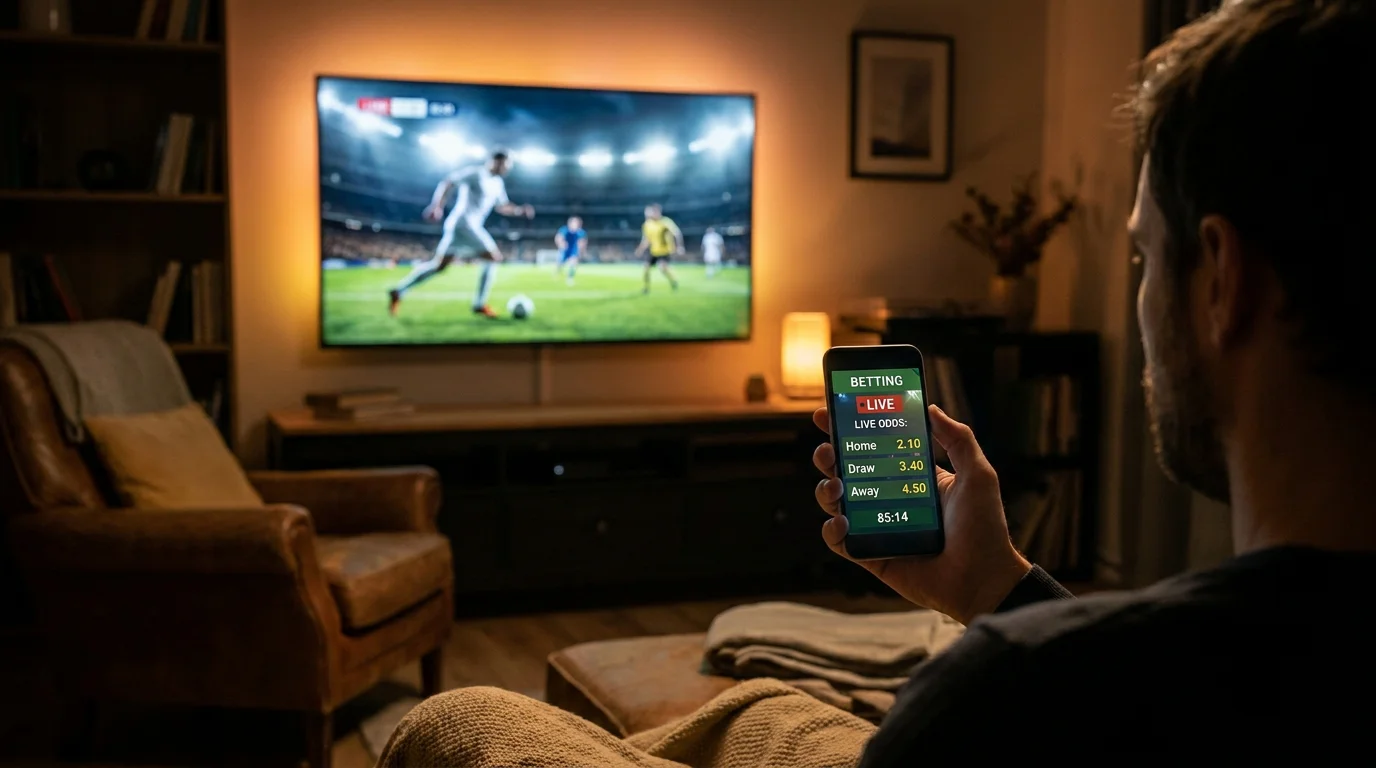
It’s the 58th minute, and the home side has just conceded from a corner. The crowd goes quiet, the odds flip, and within seconds the away team’s price to win has shortened from 4.50 to 2.80. You watched the match unfold, you saw the goal coming before it happened — the home defence had been sitting deeper and deeper, the away side had won six corners in fifteen minutes. That moment, where your live observation meets a shifting market, is the entire appeal of in-play betting. And it’s why the market is growing faster than any other segment of UK football wagering.
Live football is the most popular format for in-play betting in the UK — 5% of all adults, and 9% of men, have placed a live bet on football in the past year. That’s a significant chunk of the roughly 290 million online bets placed on real events each month. The appeal is straightforward: you can see the match before you commit money, which feels like it reduces uncertainty. The reality is more nuanced. In-play markets are fast, volatile, and priced by algorithms that update in fractions of a second. Beating them requires a specific skill set that differs meaningfully from pre-match analysis.
I’ve been trading in-play markets for seven years, and the edge isn’t where most people think it is. It’s not about reacting faster than the algorithm — you can’t. It’s about reading the match in ways the model doesn’t, and acting in the windows where the market’s adjustment lags behind what’s actually happening on the pitch. 32% of mobile bettors in the UK are aged 18 to 24, a demographic that grew up with live betting as the default experience rather than the novelty it was a decade ago. The rest of this article explains how to approach that experience with strategy rather than impulse.
How Live Odds Move: The Model Behind the Numbers
The first time I tried in-play betting, I assumed the odds were set by a human watching the match. They’re not. In-play prices are generated by statistical models that update based on discrete events: goals, red cards, minutes elapsed and — in more sophisticated systems — expected goals accumulated during the match. Understanding what the model responds to, and what it misses, is the foundation of live betting strategy.
The core variable is time. As minutes tick away, the model adjusts the probability of each outcome based on the current scoreline and the time remaining. A 0-0 at half-time means the draw price shortens, the favourite’s price drifts, and the underdog’s price drifts further. This is purely mechanical — the model knows that fewer minutes remain for the pre-match favourite to assert their superiority. By the 70th minute at 0-0, the draw often becomes the shortest-priced outcome regardless of which side has dominated the match. That’s a critical blind spot, and it’s where informed bettors find their edge.
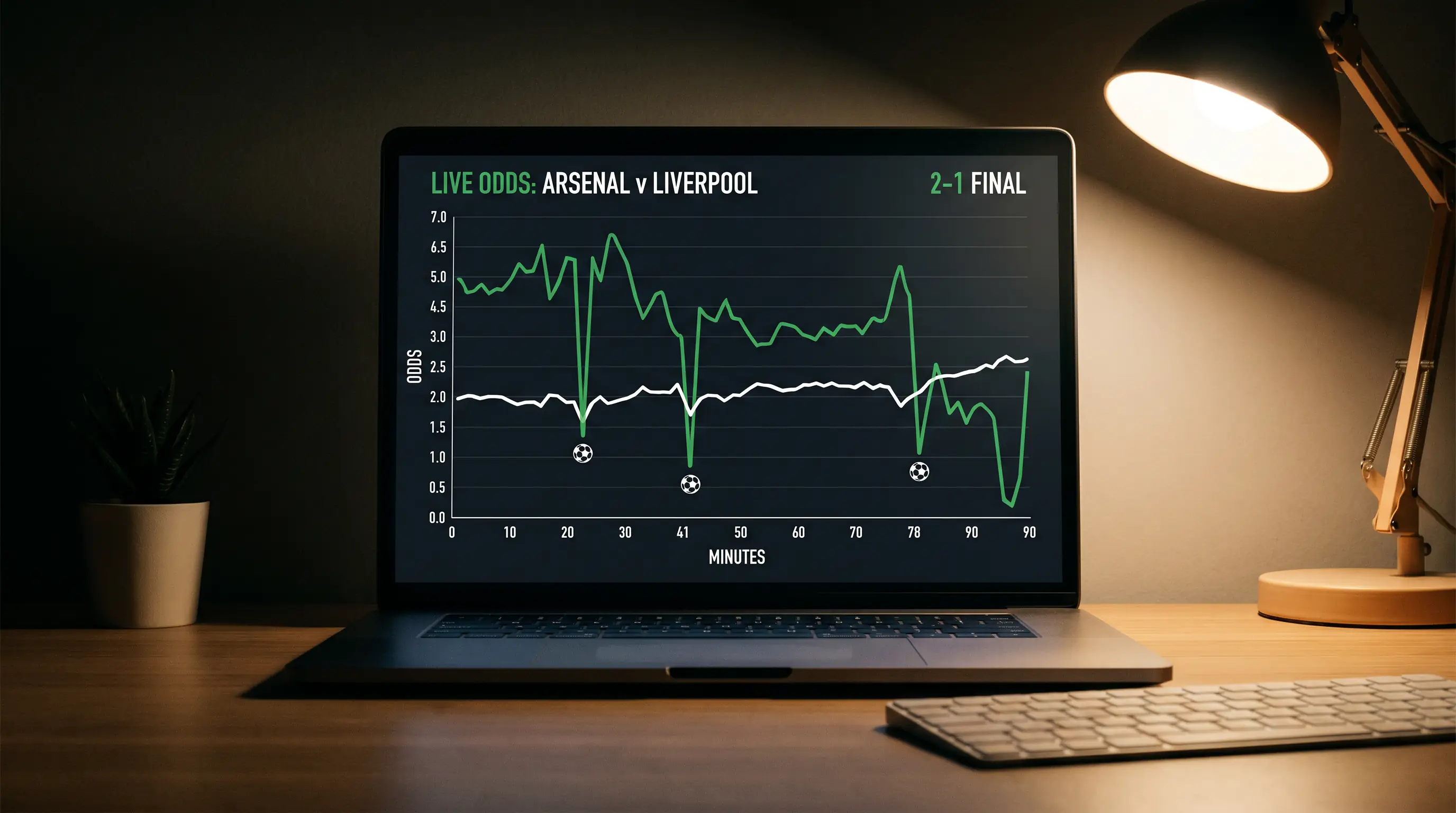
Goals produce the largest and most sudden price movements. A goal for the pre-match underdog flips the market dramatically — the bookmaker’s model essentially reprices the entire match from scratch based on the new scoreline and remaining minutes. Red cards produce the second-largest adjustment, though the model tends to overcorrect here. A red card in the 30th minute reduces the disadvantaged team’s win probability by a significant margin, but it also changes the tactical shape of the match in ways the model doesn’t fully capture: the ten-man team often sits deep and compact, reducing the opponent’s chance creation more than the raw xG data would predict.
What the model doesn’t see — and this is crucial — is momentum, fatigue and tactical shifts. Bookmaker margins on football markets run 4% to 7% pre-match, but in-play margins tend to be wider, often 6% to 10%, because the bookmaker is pricing in their own uncertainty about the live state of the match. That wider margin means your edge needs to be larger to overcome it. But the model’s inability to process qualitative information — a manager making a double substitution to change shape, a defender visibly tiring, a side switching from 4-3-3 to 3-5-2 — creates pockets of mispricing that a knowledgeable viewer can exploit.
Momentum Bias: The Mistake Most Live Bettors Make
Here’s a scenario I’ve watched play out hundreds of times. A mid-table side goes 1-0 up against a top-six team at home. The crowd roars. The home side wins a corner, then a free kick, then a throw-in deep in the opponent’s half. In the betting markets, money floods in on the home side — the price crashes from 3.00 to 1.90 within five minutes. The top-six team looks rattled. “Momentum” favours the hosts. Except it doesn’t. What’s actually happening is a temporary emotional surge that the data doesn’t support. The top-six side’s xG is still higher, their possession is recovering, and historically, sides that go behind early at this level equalise within twenty minutes in roughly 35% to 40% of cases.
Momentum bias is the single most common cognitive error in live betting. It’s the belief that what’s happening right now will continue happening. A team that’s just scored “has the momentum.” A team that’s just missed a chance is “on top.” These narratives feel real because they match the emotional arc of watching a football match in real time. But football is a low-scoring sport where the next goal can come from either side regardless of who “feels” like the better team in the current phase of play.
I’ve trained myself to do the opposite of what momentum bias suggests. When a mid-table side scores against a top-six opponent and the market overcorrects, I look at the in-play xG data. If the underlying chance creation still favours the trailing team, the market has overreacted to the scoreline — and the trailing side’s price now represents value. This isn’t contrarianism for its own sake. It’s a systematic response to a predictable market error caused by the crowd following emotion rather than process.
The practical discipline is simple: never bet in the three minutes immediately following a goal. Wait for the emotional spike to pass, let the market stabilise, and then assess whether the new prices reflect the actual balance of the match. That three-minute pause has saved me more money than any analytical tool I’ve ever used.
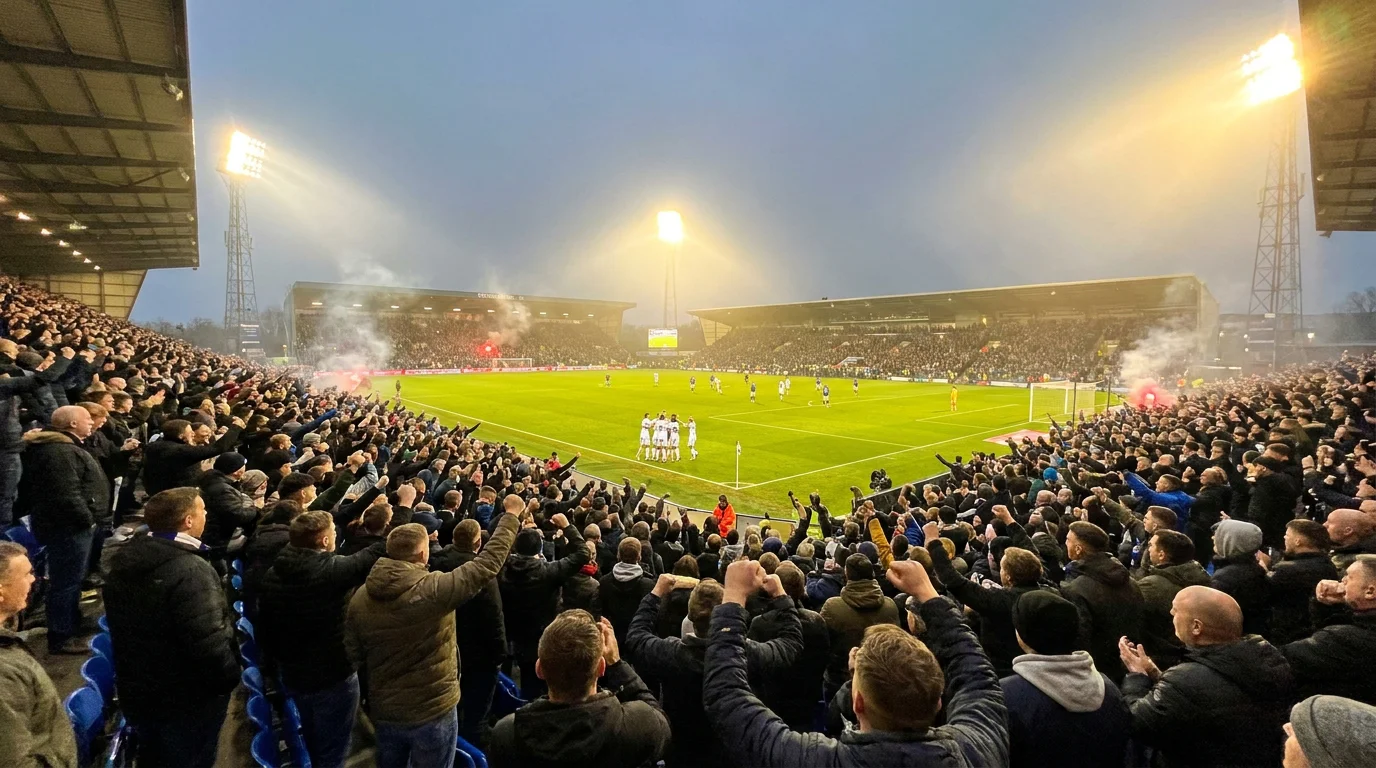
There’s a subtler version of momentum bias that catches even experienced live bettors. It happens when a side dominates possession and territory without scoring — hitting the post, forcing saves, winning corners. The commentary says they’re “knocking on the door.” The market shortens their price. But if the xG data shows their chances are low-quality — shots from distance, headers under pressure, blocked efforts — the dominance is illusory. The team creating the better chances might be the one sitting deep and hitting on the counter with two clear-cut opportunities. I’ve learned to trust the quality of chances over the volume of territory, and that distinction alone has sharpened my live betting significantly.
The Equalising-Goal Edge: Backing the Underdog at the Right Moment
I keep a private spreadsheet of every in-play bet I’ve placed since 2019. When I analysed it last summer, one pattern stood out above all others: my best-performing live strategy was backing the trailing favourite after they go behind in the first half.
The logic is straightforward. When a clear pre-match favourite concedes early — say within the first twenty-five minutes — their price drifts dramatically. A side that was 1.60 pre-match might be available at 3.00 or higher at 0-1 down. The market has priced in the current scoreline and the time deficit. What it often underprices is the behavioural response: trailing favourites increase their intensity, their manager makes tactical adjustments, and the team that scored first frequently sits deeper to protect their lead, which paradoxically makes them more vulnerable to sustained pressure.
Research on xG-based models has shown that backing home wins specifically generates the strongest returns — and this effect intensifies in live markets when the home side is trailing. The crowd lifts, the manager throws on an attacking substitute, and the side pushes forward with a desperation that’s hard to sustain but genuinely effective in the short term. The equalising goal in these scenarios comes more often than the in-play odds imply.
My rules for this approach are strict. I only back the trailing side when: they were pre-match favourites at odds below 2.00; the first goal came before the 35th minute; the in-play xG still favours them or is close to level; and there’s no red card complicating the picture. When all four conditions are met, the price on the trailing favourite often overreacts to the scoreline, and backing them — typically on a “draw no bet” or “double chance” market to reduce variance — has been my most consistent in-play edge over six years of data.
The critical nuance is patience. Not every trailing favourite deserves your money. If the underdog scored through a well-constructed counter-attack and their defensive shape looks organised, the favourite may genuinely struggle to break through. Context matters: a trailing favourite at home to a newly promoted side is a different proposition from a trailing favourite away at a top-four rival. I use the first fifteen minutes after the goal to assess the response — is the favourite increasing their tempo, or are they becoming frustrated and sloppy? The answer determines whether I bet or stand aside.
Picking Your Live Markets: Next Goal, Corners, Cards
Most in-play bettors default to the match result market. That’s the most visible, most liquid and — unsurprisingly — the most efficiently priced live market available. If you want to find genuine value in-play, you often need to look beyond that default and into the markets that attract less money and less algorithmic attention.
Next goal is a market I use frequently between the 60th and 75th minutes, when the match state is clearest. By that point, I can see which side is pushing, which manager has made attacking substitutions and whether the trailing team’s body language suggests they’ve accepted the result or are still fighting. The next goal market carries a wider margin than match result, so I only bet when the visual evidence is overwhelming — not when I have a mild preference.
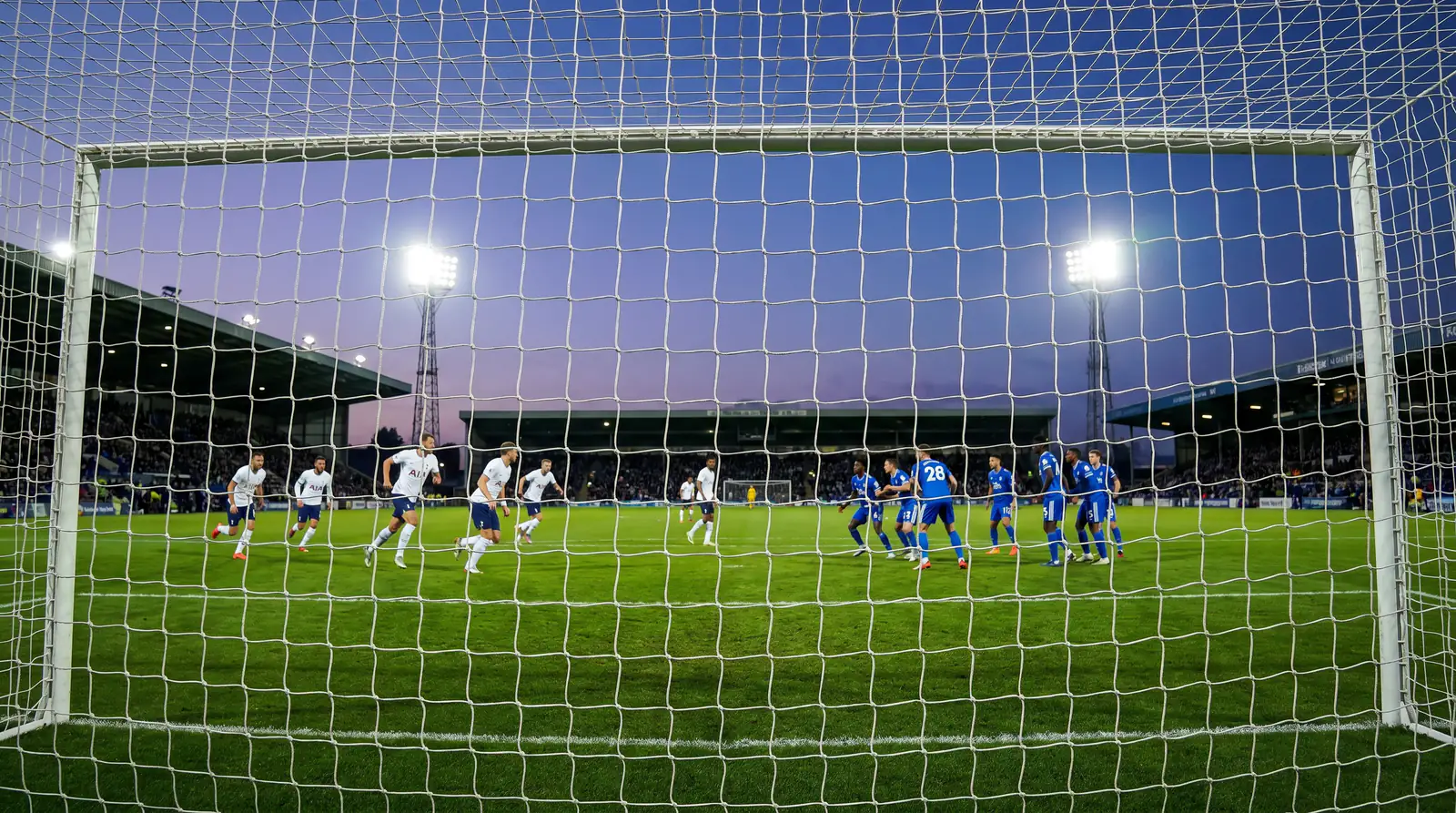
Corners are the most underrated in-play market for viewers who pay attention to tactical shape. A side chasing the game typically pushes full-backs higher, puts more crosses into the box and generates more corners in the final third of the match. If a team trailing 0-1 makes attacking substitutions at the 60th minute, I’ll look at the live corners over/under line. The bookmaker’s model adjusts for scoreline and time but doesn’t fully account for the tactical shift. I’ve found consistent edge in backing “over” on the total corners line in matches where the trailing side has made two or more attacking changes.
Cards are driven by match tension and referee tendencies. Derbies, relegation battles and high-stakes cup ties produce more cards, particularly in the final twenty minutes when frustration builds. I track referee statistics — cards per game, average booking minute, propensity to card for dissent versus tactical fouls — and use that data as a filter for live booking points markets. The key insight: referees who have been lenient in the first half often overcompensate in the second half, particularly if the match becomes physical. That delayed enforcement creates a predictable spike in cards that the live market doesn’t fully price.
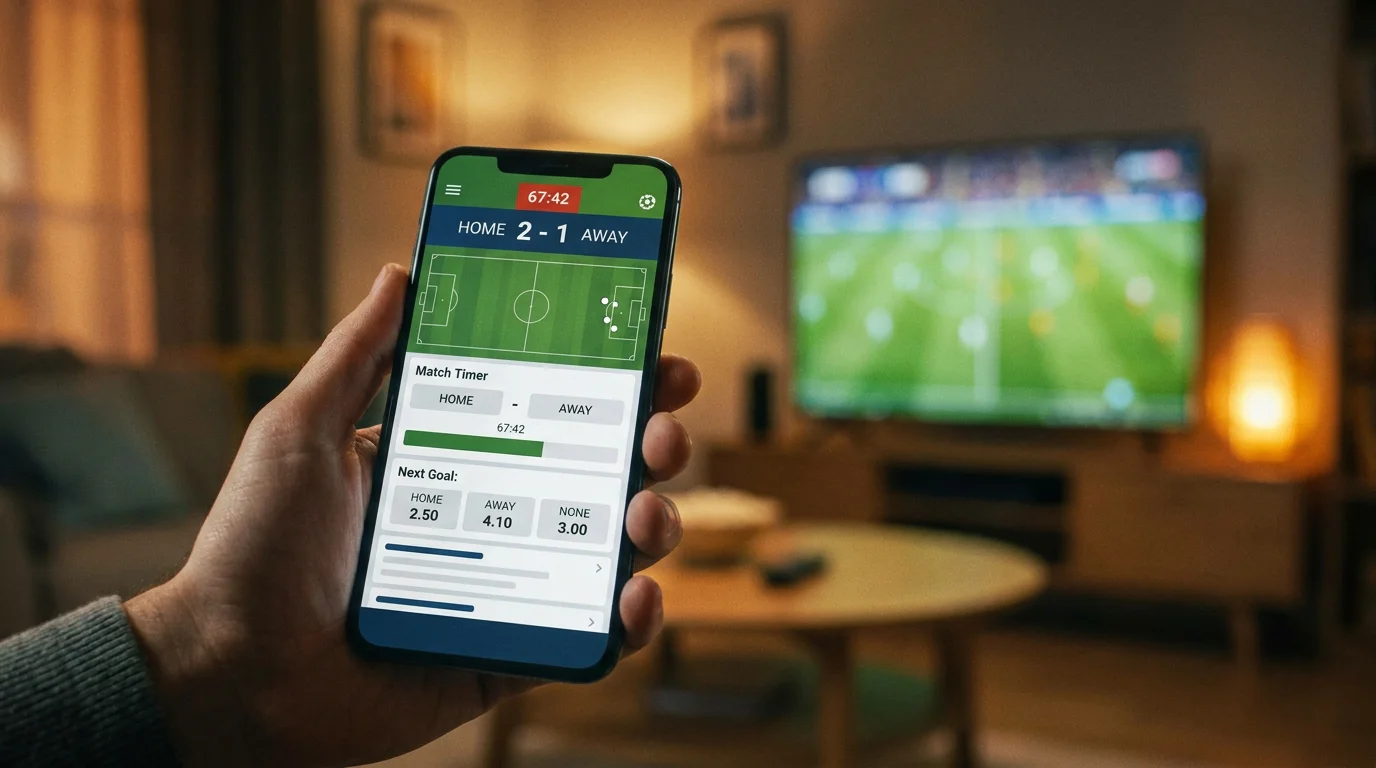
95% of UK online gambling happens from home, and the majority of live bettors are watching on a screen while the match unfolds. That shared viewing experience means the market reacts to what everyone can see. The edge lies in noticing what the casual viewer overlooks — the full-back who’s stopped overlapping, the defensive midfielder picking up a slight limp, the shift in shape that precedes a change in match dynamics. Watching actively, not passively, is the difference between entertainment and edge. Train yourself to narrate the match tactically as it unfolds — who’s pressing high, who’s sitting deep, where the space is opening up — and the live markets will start making far more sense.
Cash-Out Timing: When to Take Profit and When to Let It Ride
I used to cash out constantly. A bet moved in my favour, the green button appeared, and I grabbed the profit. It felt like smart risk management. When I reviewed a year of data, the reality was different: cashing out early had cost me hundreds of pounds in expected value. The cash-out price always includes a margin — the bookmaker doesn’t offer you fair value, they offer you less than fair value — and accepting it repeatedly compounds into a significant leak.
The cash-out feature is designed to feel like a tool for the punter but function as a revenue stream for the operator. Rachel Reeves, as Chancellor of the Exchequer, noted that online gaming and online betting produce more serious harms than in-person betting — and cash-out is one of the mechanisms that fuels impulsive decision-making. It invites you to make a new bet (the decision to accept or reject the cash-out price) within a bet you’ve already placed, often under emotional pressure while watching a live match. That’s not risk management; it’s a second opportunity for the bookmaker to extract margin.
My current approach is simple: I only cash out when my live assessment of the match has fundamentally changed since I placed the bet. If I backed a team to win at half-time and they’ve since had a player sent off, the match context has shifted in a way my pre-bet analysis didn’t account for. Cashing out in that scenario is a rational response to new information. If nothing has changed except the scoreline moving in my favour and the green button looking tempting, I let the bet run.
There’s one exception. If I placed a pre-match bet and the in-play data reveals I fundamentally misread the match — the team I backed is being outshot, out-chanced and outplayed despite leading — I’ll consider cashing out not because of the green button but because my original thesis was wrong. Accepting a reduced profit when your analysis was flawed is different from surrendering value because you’re nervous. The distinction matters, and keeping a log of every cash-out decision and its reasoning has helped me tell the two apart over time.
For a deeper breakdown of how operators price cash-out offers and a framework for making those decisions methodically, I’ve written a dedicated cash-out guide that goes into the maths step by step.

FAQ
Is in-play betting more profitable than pre-match?
Not inherently. In-play markets carry wider margins and require faster decision-making, which increases the risk of emotional errors. The advantage is that you have more information — you can see the match unfolding. My best results come from a combination: pre-match analysis to form a view, then in-play execution to find the best price if the match develops as expected. Treating in-play as a standalone strategy without pre-match preparation is a recipe for impulse betting.
How quickly do live odds react to goals and red cards?
Goals are priced in within two to five seconds on most UK bookmaker platforms. Red cards typically take five to fifteen seconds because the model needs to assess the impact more carefully. In practice, you cannot beat the algorithm’s speed of reaction to discrete events. The edge lies in reading the build-up to those events — the tactical shift, the fatigue, the change in shape — before they happen, and positioning yourself accordingly.
What internet speed do I need for live football betting?
Any stable broadband connection above 10 Mbps is more than sufficient. The limiting factor isn’t bandwidth but latency and stream delay. TV broadcasts run fifteen to sixty seconds behind real time, which means someone at the ground or on a faster stream sees events before you do. I avoid betting on immediate outcomes like next goal when I suspect my stream is delayed, and instead focus on broader market positions — match result, total goals, corners over/under — where a few seconds’ delay doesn’t materially affect the price.
