

 Available in US
Content
A Market Driven by Referees, Not Footballers
Most football betting markets are about what the players do – score goals, create chances, win tackles. Booking points are different. This market is fundamentally about a single individual who is not on either team sheet: the referee. I realised this four seasons ago when I noticed that two nearly identical fixtures – same teams, same venue, similar form – produced wildly different card counts depending on who was officiating. The match with a lenient referee produced twenty booking points. The match with a strict one produced sixty-five. Same game, same players, completely different market outcome.

That observation sent me down a data rabbit hole that has become one of my most reliable edges. With 290 million online bets placed monthly in the UK, the booking points market attracts a tiny fraction of that volume compared to match result or goals markets. The low liquidity means bookmaker pricing is less refined, and a bettor armed with referee-specific data can consistently find lines that do not reflect the likely card count for a given official.
Profiling Referees: Cards Per Game, Advantage Play, Derby Bias
Referee profiling is straightforward in principle but requires consistent data collection. The core metric is cards per game, split into yellow and red. In the Premier League, referees average between three and five yellow cards per match, but the range within that average is wide. Some officials sit consistently at the bottom – two to three yellows per game – while others reliably push toward five or six. That two-to-three-card spread on a single metric changes the expected booking points total by twenty to thirty points, which is often enough to push the match over or under the bookmaker’s line.
Beyond raw card count, I track two additional dimensions. The first is advantage play tendency – how often a referee allows play to continue after a foul rather than stopping it immediately. Referees who play advantage more frequently tend to issue fewer cards because they penalise the foul with a free kick or advantage rather than a booking. Referees who stop play for every infringement are more likely to reach for the yellow card, particularly for persistent fouling.

The second dimension is context sensitivity. Some referees show a measurably higher card rate in derby matches, relegation clashes, and other high-intensity fixtures. The emotional temperature of the game affects their threshold. I have one referee in my database who averages 3.2 yellows per game in routine fixtures but 5.1 in matches between teams separated by fewer than six league positions. That context sensitivity is not captured in the headline cards-per-game average, and it creates a specific, exploitable edge when that official is assigned to a high-stakes match.
Football generates GGY of more than a billion pounds annually in the UK, and the disciplinary markets represent a small but growing segment of that. Bookmakers price booking points lines using team-level disciplinary data – fouls committed, cards received – but they underweight the referee variable. My model weights the referee at roughly 40% and the team combination at 60%, and the discrepancy between my predicted booking points and the bookmaker’s line is consistently wider than the equivalent gap in goals or corners markets.
How Booking Points Are Calculated and Where the Value Sits
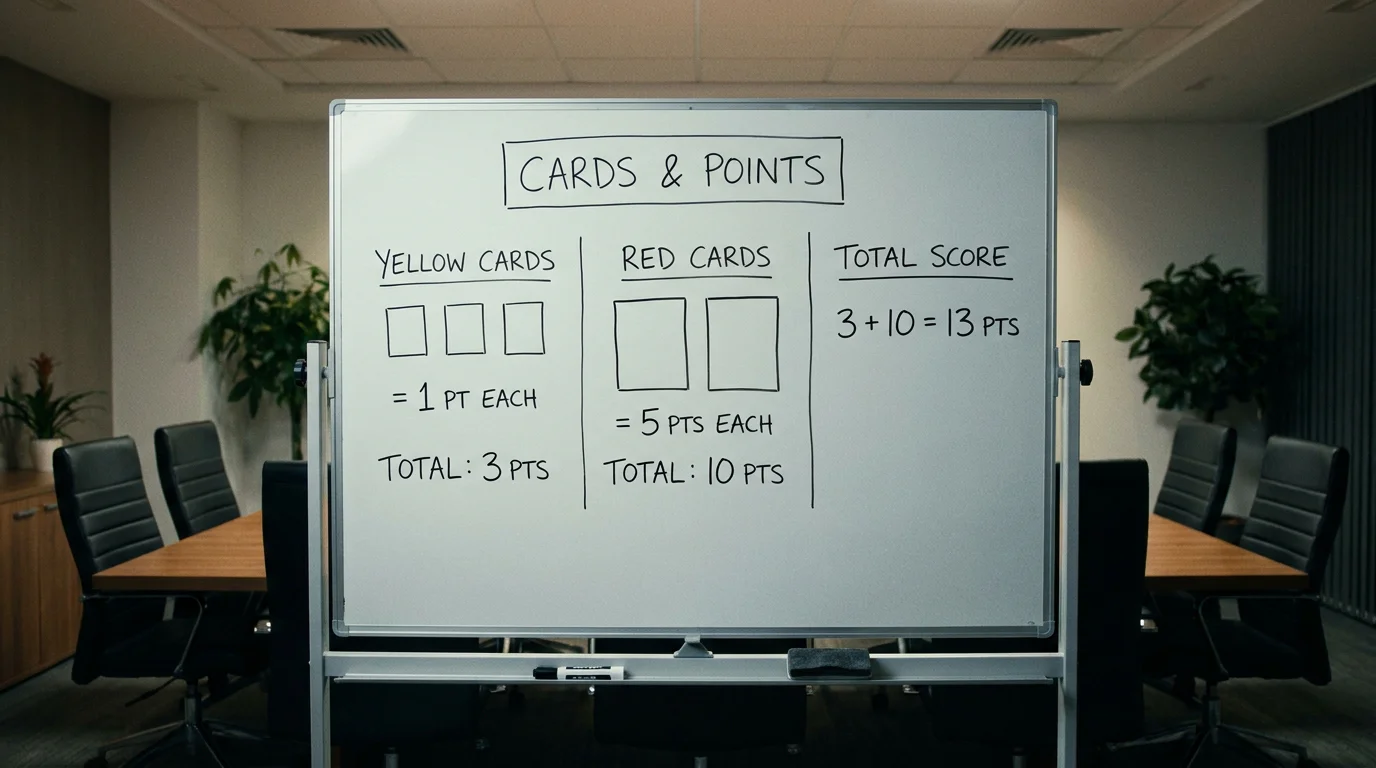
For anyone new to this market: booking points assign ten points for a yellow card and twenty-five for a red. A second yellow followed by a red counts as thirty-five (ten plus twenty-five). The total for a match is the sum of all booking points awarded to both teams. A typical Premier League match produces between thirty and fifty-five booking points, though high-intensity derbies can reach seventy or more.
The bookmaker sets a line – say, 45.5 – and you bet on whether the actual total will be over or under. The margin on booking points markets is typically 5-7%, sitting at the wider end of the range that bookmakers charge across football. That wider margin is a cost, but it is offset by the frequency of mispricing, which is higher than in goals markets precisely because less analytical attention goes into the pricing.
Where I find the most consistent value is in the intersection of a card-happy referee and a match with high foul potential. Relegation scraps between physical sides, local derbies in the lower divisions, and matches where one team is defending a narrow lead in the second half all produce elevated foul counts. When the referee assigned to these fixtures has an above-average card rate, the expected booking points climb well above the typical line – and the bookmaker’s pricing often does not fully reflect this convergence.

The opposite edge exists too. When a lenient referee is assigned to a match between two possession-based sides with low foul rates, the booking points total is likely to land near the bottom of the range. Backing under on these fixtures at the standard line of 42.5 or 45.5 has been a steady contributor to my returns.
One caveat: red cards are high-variance events that can blow up any booking points prediction. A single straight red adds twenty-five points and often triggers retaliatory fouls and further yellows. My approach accounts for this by sizing my booking points stakes smaller than my goals or corners stakes – the edge is real, but the variance is higher on individual matches. The edge reveals itself over a sample of fifty to one hundred bets, not in any single fixture.
Cards data also feeds into same-game multis. If you are building bet builders that combine booking points with corners or shots, the corners betting strategy uses similar data-driven logic.
How are booking points calculated in football betting?
Yellow cards are worth ten points and red cards twenty-five. If a player receives a second yellow and is then shown a red, the total is thirty-five points (ten for the first yellow plus twenty-five for the red). The match total is the sum of all booking points awarded to players on both teams. Most bookmakers set a total line between 40 and 50 for a standard Premier League fixture.
Do certain referees consistently give more cards?
Yes, and the variation is significant. In the Premier League, the gap between the most lenient and most strict referees is typically two to three yellow cards per match, which translates to a twenty-to-thirty-point swing in expected booking points. This consistency persists across seasons, making referee assignment one of the most predictable variables in football betting. Check the referee appointment for each fixture and compare their season average against the booking points line before placing any bet in this market.
